PVST+ (Per VLAN Spanning Tree Plus)
PVST+ (Per VLAN Spanning Tree Plus) is a
Cisco proprietary STP version. It is also the default
STP version for Cisco devices. It is the standard named 802.1d. In another lesson, we will see the
configuration of PVST+ on Cisco Routers.
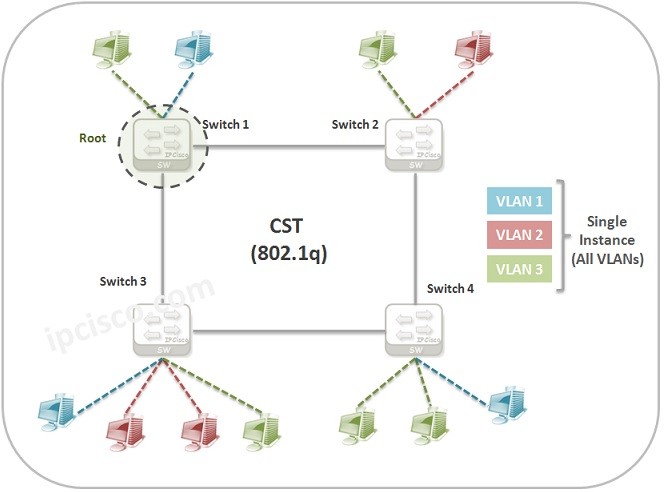
In normal STP,
CST (Common Spanning Tree), only one instance can be used for the whoşe network. There is no specific instances per VLAN.
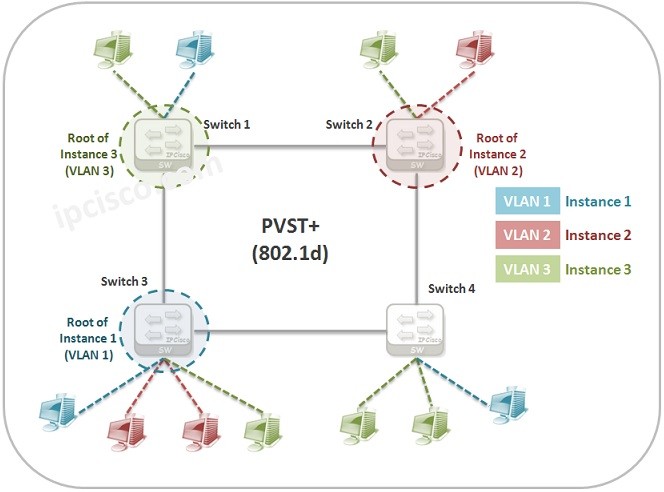
 PVST+ (Per VLAN Spanning Tree Plus)
 creates an instance for each VLAN and in each instance, a different STP process occurs, a different
Root bridge is selected, different port roles are used etc.
There are some advantages and disadvantages of
PVST+ if we compare it with normal
STP (CST). What are these advantages and disadvantages? Let’s check.
For the network performance,
PVST+ is a better selection than STP. Because, in
PVST+, STP process is done for a small group of devices, for the devices in the same VLAN. Not for the whole devices in that network.
The performance is better in
PVST+ than normal
STP (CST), but, here the CPU and memory usage are more. This is one of the disadvantages of
PVST+. Beside, the convergence time is also higher than CST in PVST+.
Another important advantage of
PVST+ is providing a good load balancing.
Rapid PVST+ (Rapid Per VLAN Spanning Tree Plus)
Rapid PVST+ (Rapid Per VLAN Spanning Tree Plus) is also a
Cisco proprietary STP version. Again, it has an instance for each VLAN and each VLAN has a separate STP process.
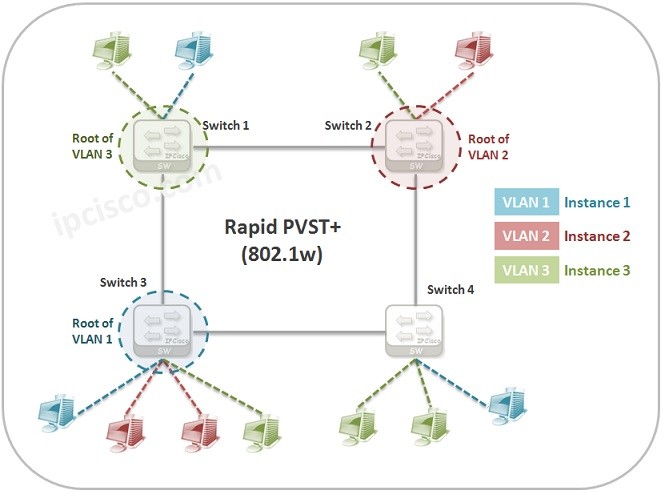
It has a faster convergence advantage if we compare it with
PVST+. Beside,
PVST+ (Rapid Per VLAN Spanning Tree Plus) need more CPU and memory resources than
PVST+.
RPVST+ has four states. These states are also the states of
MST (Multiple Spanning Tree) that we will discuss later. RPVST+ States are given below:
- Blocking
- Learning
- Forwarding
- Disabled
[sc name=”ContentRMessage”]