OSPF Adjacency States
Routers establish
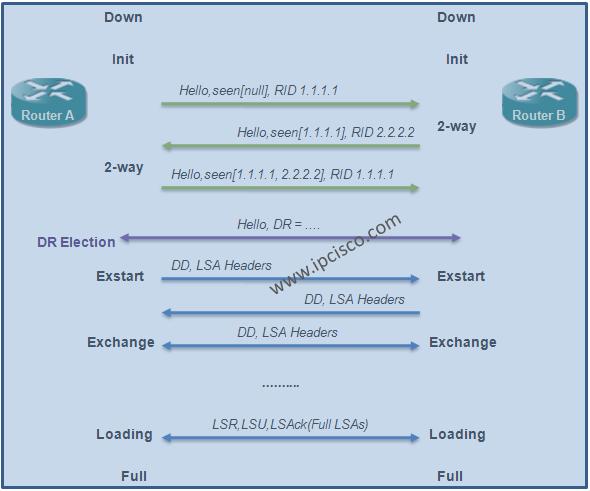
OSPF adjacency to use OSPF. From the beginning of the establishment to the full adjacency, there are some states. These states are mentioned below:
 OSPF (Open Shortest Path First) Neighbourship States
• Down
• Init :
OSPF (Open Shortest Path First) Neighbourship States
• Down
• Init : Hello packet received without Router ID.
• 2-Way : Bi-directional communication is established by Hellos. DR and BDR election occurs.
• Exstart : Preparing to the Link-state exchange. Fort his Exchange, Master and Slave sides are selected
• Exchange : Exchange of DD packets, which contain the description of Topology Databases. Topology Database comparison with neighbours.
• Loading : Topology Database sharing with neighbours.
• Full : Full syncronization is established. The Topology Databases are identical.
Basically, the states of OSPF neighbour adcajency are like above. During these states, there is an important process called “
DR and BDR Selection“. Let’s talk about, how is these selection is done.
OSPF DR and BDR Selection
DR(Designated Router) and
BDR(Backup Designated Router) are the two routers in the Multi-Access OSPF network, that works as
Master and Backup. Here, the Multi-Access word is important. Because there is no DR and BDR selection in
point-to-point networks.The other remainning routers in OSPF network are called as
Non-DR.
[sc name=”ContentRMessage”]
Other Main OSPF Articles…
Routing with OSPF – Part 1
Routing with OSPF – Part 2 (OSPF Adjacency)
Routing with OSPF – Part 3 (OSPF Packet Types)
Routing with OSPF – Part 4 (OSPF LSA Types)
Routing with OSPF – Part 5 (OSPF Area Types)
Routing with OSPF – Part 6 (OSPF Network Types)
Routing with OSPF – Part 7 (OSPF OSPF Router ID, Virtual Links, Authentication, Timers)
OSPF Single Area Configuration on Cisco