OSPFv2 Overview
OSPF (Open Shortest Path First) is a
Link-State Routing Protocol. It is also
Classless and an
Open,
Standard Protocol used by all vendors. OSPF uses
Dijsktra Algortihm, a
Shortest Path First Algorithm (SPF) to determine the best path to a destination network. In this lesson, we will focus on
Open Shortest Path First and we will learn the details of this
Routing Protocol.
OSPF Tables
Open Shortest Path First provides
neighborship between other OSPF routers by the help of
OSPF messages. With these messages, different tables are built. And
Open Shortest Path First routing mechanims works with these tables. Basically, there are
three tables. These tables are :
- Neighboring Table
- Topology Table
- Routing Table
In
Open Shortest Path First, all routers build its own
Topology Table and has the full view of the network. It calculates the next hope independently from other routers. This is also the characteristic of
Link-State Protocol. As you remember, Link-State protocols are “
OSPF” and “
IS-IS“. In
Distance-Vector protocols, the situation is not like this.
Distance-Vector protocols needs a neighbor to know about the network.
Hierarchical Design and Area Types
Open Shortest Path First has an
hierarchical architecture. It uses “
Areas” for hieararcy. There is a
Backbone Area as
Area 0 in the center for all OSPF Networks. Around this
Backbone Area, Area 0, there are some other Areas. All these areas are connected to this Area 0. If there is a uncontinuous structure,
Virtual-Links can be used to connect an area to the
Backbone Area(Area 0).
With this
hierachical architecture of OSPF, you can divide your network into different small areas and by doing this, you can reduce overhead of this small areas. You can also use specific areas in
OSPF network. These areas will be explain detailly later.
Here, let’s only give the
area types used in OSPF:
- Standard Area
- Backbone Area (Area 0)
- Stub Area
- Not So Stubby Area (NSSA)
- Totally Stub Area
- Totally NSSA
We will talk about the details of these areas in the following articles.
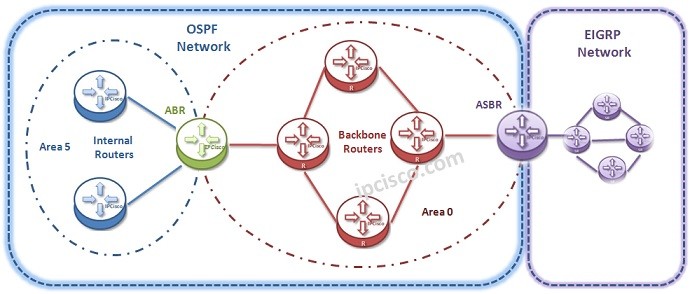
OSPF Router Types
In
OSPF Design there are different
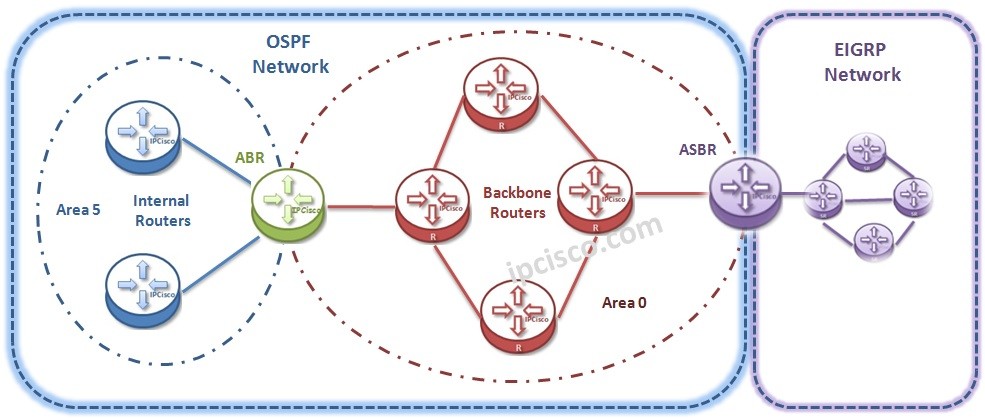
Router types. These router types are named according to their roles and their place of the network. Let’s see these router:
- Internal Routers : Routers in a Single Area.
- Backbone Routers : Routers in Backbone Area (at least one interface).
- Area Border Routers(ABRs) : Routers have interfaces at least in two areas.
- Autonomus System Boundary Routers(ASBRs) : Routers connected to an another AS and redistribute external routes.
OSPF Administrative Distance Values
For Best Path selection, Administrative Distance(Preference) values are very important. Every Routing Protocol has an AD value. The
Administrative Distance (Preference) of the
Open Shortest Path First is
110 for
Cisco devices. This is a little different for Alcatel-Lucent, Huawei and Juniper devices. They use Interneal and External Preference values for
Open Shortest Path First. Preference value is
10 for
Internal OSPF Routes and
150 for
External OSPF Routes on the devices of these vendors.
Open Shortest Path First Cost
Open Shortest Path First uses path Cost as its metric. Generally Bandwidth value is used as path Cost. AS a formula, the Cost is calculated like below in OSPF:
Cost = Reference BW(default 10 000 000) / BW
OSPF Versions
Protocols are developed and then they enhanced with new features. This new enhanced versions came with new versions.
Open Shortest Path First also has different versions. There are
two OSPF versions. These are:
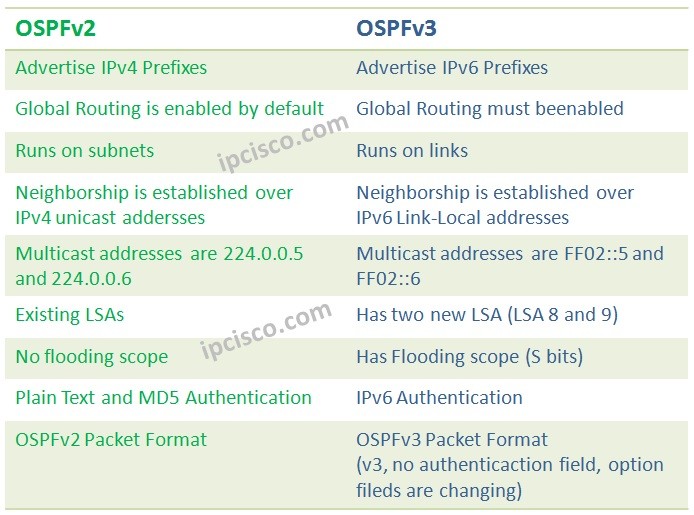
OSPFv2 is the first version of
Open Shortest Path First and it is used with
IPv4.
OSPFv3 is the enhanced version of OSPFv2 that supports and designed for
IPv6.
In the below table, you can check the differences of these two versions as summary.
In this article, we have talked about an overview of
OSPFv2. In the following articles, we will explain this lesson more deeply. If you want to learn more about
OSPFv3, you can check IPv6 Routing Protocols lesson.

[sc name=”ContentRMessage”]