

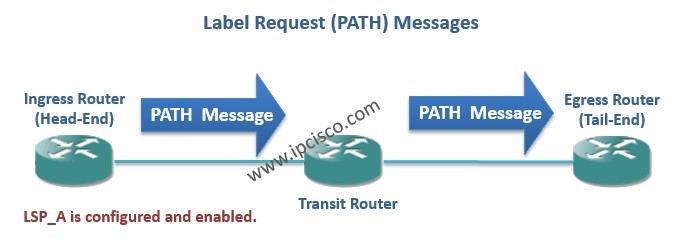
RSVP-TE(Resource Reservation Protocol-Traffic Engineering) is the enhanced RSVP for MPLS. RSVP-TE is not a real routing protocol, but it works with routing protocols.
For RSVP-TE, bidirectional flow is required. To provide this, there must be two RSVP sessions. Because RSVP-TE is unidirectional.
RSVP-TE brings some benefits to MPLS. These benefits are:
– Ability to define LSP paths, path choice by administrator.
– Advanced cost calculation, not restricted to IGP cost values.
– Rich set of traffic protection (secondary paths and fast reroute).
– Ability to make resource reservation functionality.
RSVP-TE Main Characteristics
As we talked about before in LDP articles, there are also some main characteristics for RSVP-TE. Some of these characteristics are different than LDP. What are these characteristics? Let’s check: – Downstream on demand : LSPs signalled when requested. ( This was unsolicited downstream in LDP, which send labels without any requests). – Ordered control : Label distribution process follows a hierarchical order (Same as LDP). – Conservative label retention : Labels are cleared if not needed. ( This was liberal label retention in LDP, which stores all the labels). [sc name=”ContentRMessage”] MPLS, RSVP-TE – Part 1 MPLS, RSVP-TE – Part 2(Alcatel-Lucent Configuration) …YOU CAN REACH ALL THE “MPLS” ARTICLES AND CONFIGURATIONS BELOW… MPLS Basics What is MPLS? Enabling MPLS on Cisco Router MPLS Label Distribution Protocol, LDP MPLS Label Distribution Protocol, LDP – Part 1 MPLS Label Distribution Protocol, LDP – Part 2 MPLS Label Distribution Protocol, LDP – Part 3 (Configuration on ALU) MPLS Label Distribution Protocol, LDP – Part 4 (ECMP) MPLS Label Distribution Protocol, LDP – Part 5 (Export and Import Policy, Prefix Aggregation) MPLS Label Distribution Protocol, LDP – Part 6 (T-LDP) MPLS Label Distribution Protocol, LDP – Part 7 (CR-LDP) MPLS, RSVP-TE MPLS, RSVP-TE – Part 1 MPLS, RSVP-TE – Part 2(Alcatel-Lucent Configuration) MPLS Protection And Restoration MPLS Protection and Restoration – Part 1 MPLS Protection and Restoration – Part 2 (End-to-End Protection, Secondary Paths) MPLS Protection and Restoration – Part 3 (Path Diversity in Secondary Paths) MPLS Protection and Restoration – Part 4 (Local Protection, Fast Reroute) MPLS Protection and Restoration – Part 5 (Fast Reroute Protection Types) MPLS Protection and Restoration – Part 6 (RSVP Objects Used for MPLS Fast Reroute) MPLS Protection and Restoration – Part 7 (Verification Commands on Alcatel-Lucent Routers) MPLS Protection and Restoration – Part 8 (Actions After the Failure) MPLS Protection and Restoration – Part 9 (Convergence Factors) MPLS Protection and Restoration – Part 10 (Juniper Configuration Samples) MPLS Protection and Restoration – Part 11 (Juniper Configuration Samples) MPLS Protection and Restoration – Part 12 (Juniper Configuration Samples) MPLS Protection and Restoration – Part 13 (Juniper Configuration Samples)You May Also Like

-
Mar 17, 2022
Networking Certifications has served as a stepping stone for those seeking to advance their careers in Networking, h they are...
-
Oct 27, 2020
LDP (Label Distribution Protocol) is one of the MPLS Label Distribution protocols that is used for label signaling in MPLS...
-
Dec 27, 2019
What is Segment Routing? Network technology is developing day by day. With this development many Technologies are coming to our...
-
Apr 17, 2019
Router Logs are very important for a Network Engineer during troubleshooting. A good Network Engineer, check the right logs and...
Sign up to receive our latest updates
[mc4wp_form id=3101]
Get in touch
Call us directly?
+1 234 567 8910
Address
Howard Street, San Francisco
contact@eduma.com