
Dynamic Routing Protocol
Dynamic Routing is the routing process that is done via a Routing Protocols in networking. The Routing Protocols that is used for this aim is also called Dynamic Routing Protocols. In this lessons, we will focus on the types of Routing Protocols. Routing Protocols can be divided into different categories according to their purpose and their operation behaviour. Here, we will see these categories and the types of these Routing Protocols in networking.You can test your Routing Knowledge on CCNP Route Practice Tests Page!
Routing Protocols According to Purpose
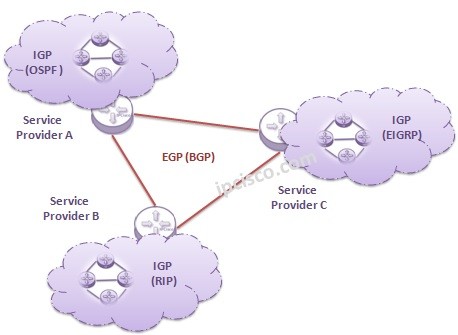
If we divide Routing Protocols according to their purpose, there are two types: These are:- IGP (Interior Gateway Protocol)
- EGP (Exterior Gateway Protocol)
IGP (Interior Gateway Protocol)
IGP (Interior Gateway Protocol) is a Routing Protocol category that are used inside an Autonomous System(AS). With Autonomous System(AS), we try to meant a network of an organization. What are these IGPs (Interior Gateway Protocol). The generaly used IGPs in Today’s network worl are given below: • RIP • EIGRP • OSPF • ISIS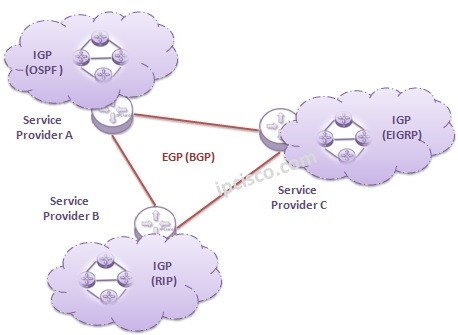
EGP (Exterior Gateway Protocol)
Beside IGP (Interior Gateway Protocol), the other Routing Protocol type according to their purpose is EGP (Exterior Gateway Protocol). Today, there is only one EGP being bused. This EGP is the wellknown protocol of Internet BGP. EGP (Exterior Gateway Protocol) is used for routing between Autonomous Systems(AS). In other words, it is responsible routing between different Organizations. This is because, BGP is used as Internet protocol. It manages the routing between diffent networks in the world and this build internet.Routing Protocols According to Operation Style
Another Routing Protocol Types are more detailed and according to their operation style. Here, we can divide Dynamic Routing Protocols in networking into four main category. These main categories are: • Distance Vector Protocols • Link-State Protocols • Hybrid Protocol • Path Vector ProtocolDistance Vector Protocols
Distance Vector Protocols are RIP, IGRP. As its name implies, Distance Vector Protocols use distance to determine the best path. This distance can be hop, cost, delay or any other parameter. According to these values, the best route is selected. Beside, Distance Vector Protocols use the outgoing interface to determine the best path. In other words, it uses both distance parameter (hop or cost or delay) and vector(direction) parameter to determine the best path.You can test your Routing Knowledge on CCNP Route Practice Tests Page!
[sc name=”ContentRMessage”]