In this lesson, we will focus on one of the most important lessons of networking. This important lesson is switching. We will learn, what is switching, switching techniques, types of switching and more. Beside we will learn many things about the widely used network equipment, switches.
Switching is done by switches basically. Switches are the basic network equipment that exist almost all networks. They are widely used network devices that has many ports and the swicthing process is done between these ports. So, what is a switch and what is swithing basically? Let’s firstly explain these terms.
 There are three phases of Circuit switcing. These Circuit Switching phases are:
 In packet switching, there are different techniques for data prioritization. Any data packet can be sent with a better priority with a better condition. Another packets can be sent over different priorities and conditions.
There are two approaches to Packet switchng. These are:
In packet switching, there are different techniques for data prioritization. Any data packet can be sent with a better priority with a better condition. Another packets can be sent over different priorities and conditions.
There are two approaches to Packet switchng. These are:
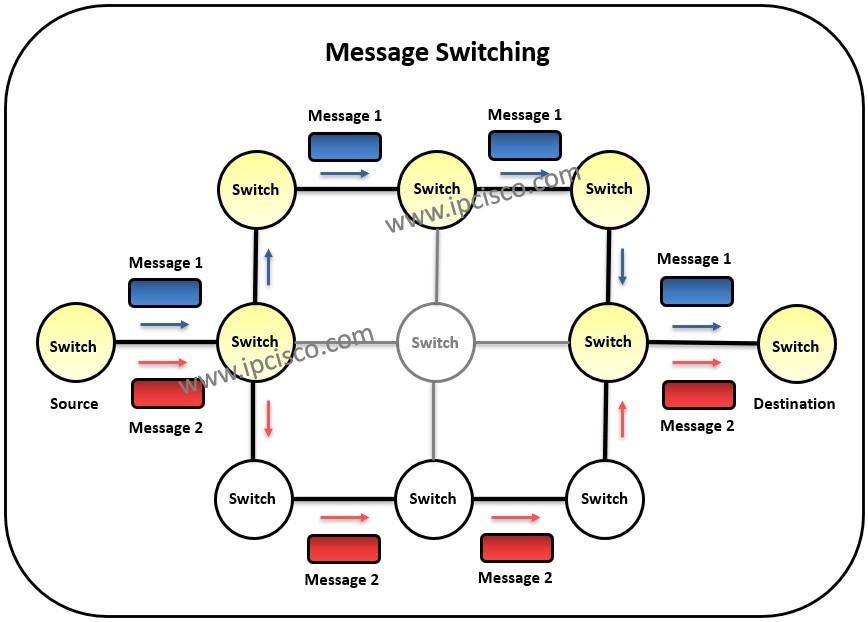 In Message switching, there is no to establish dedicated circuit between originator and the destination. The message includes the destination address and according to this message, dynamic routing is done between the sender and the receiver.
What is Switch?
A switch is a basic network equipment that is widely used almost in all network types. They are responsible for switching in a network. Basically, they take the packets and device the destination according to the tables inside it and then it forwards the packet to the destination. There are different types of switches. Some of them are used for small networks and for lower tasks and some of them are used for large networks and for too many tasks. According to their usage, we can divide switches into two:- Layer 2 Switches
- Multi Layer Switches
What is Switching?
Switching is one of the most important process in network World with routing. So, what is swithing? Swicthing is the process of forwarding incoming packets from a port, to another port. In switching there are two keywords for the ports used in this process. These are: Ingress port and Egress port. Ingress port is the port that the packet comes and the egress port is the port that the packet is forwarded. Commonly, swithcing can be divided into two categories according to connection type. These are:- Connectionless
- Connection Oriented
Types of Switching
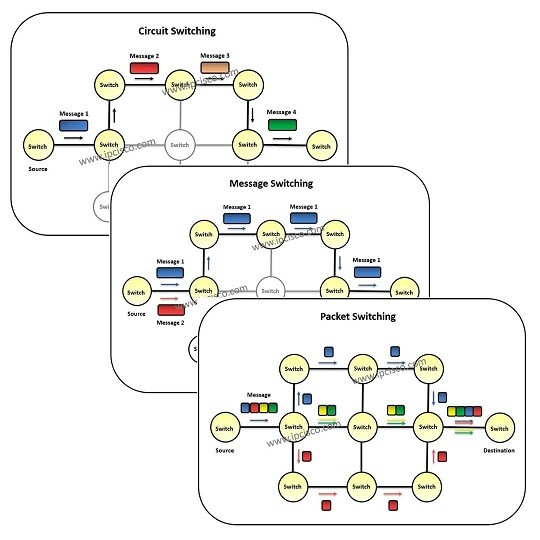
Different switching techniques can be used in different applications. So, what are these types? These are:- Circuit Switching
- Packet Switching
- Message Switching
Circuit Switching
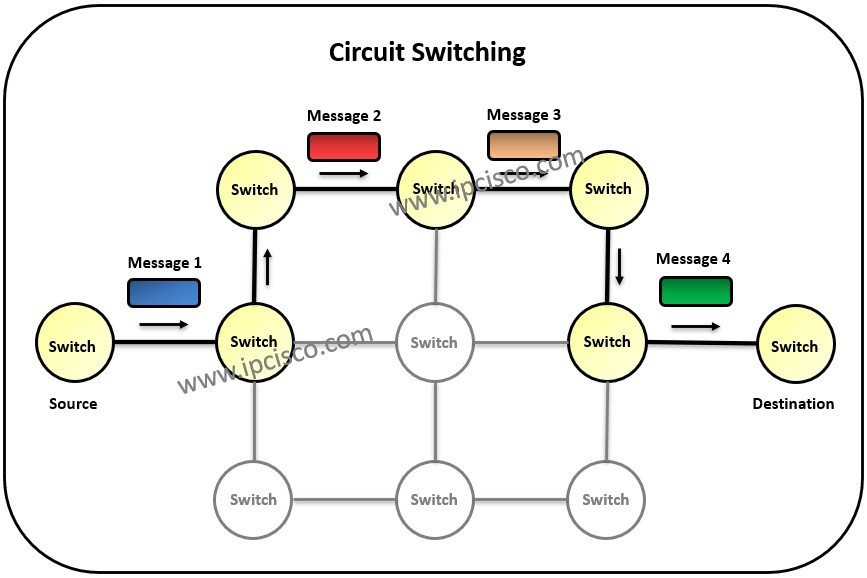
Circuit switching is the swithcing type with which dedicated communication paths (circuits) are used. In this type of switchhing, a dedicated circuit (path) is established and the communication occurs over this circuit. During the session this path remains and after termination of the communication, circuit is also terminated. In Circuit swithcing, the circuits can be permanent or temporary. According to your need, you can select one of these types.
There are three phases of Circuit switcing. These Circuit Switching phases are:
- Circuit Establishment
- Data Transfer
- Circuit Disconnect
What are the advantages of Circuit Switching?
The advantage of this type of swicthing is using dedicated channels. These dedicated channels are fixed channels that are used specifically for this communication.What are the disadvantages of Circuit Swicthing?
In Circuit Switching, session establishment need for time so this causes more delays. The dedicated channel has advantages but they are expensive. So, this is an expensive solution. Beside this, if you do not use it enough, your resource can be wasted. This type works on dedicated paths. So, you can not use another data over this channel.Packet Switching
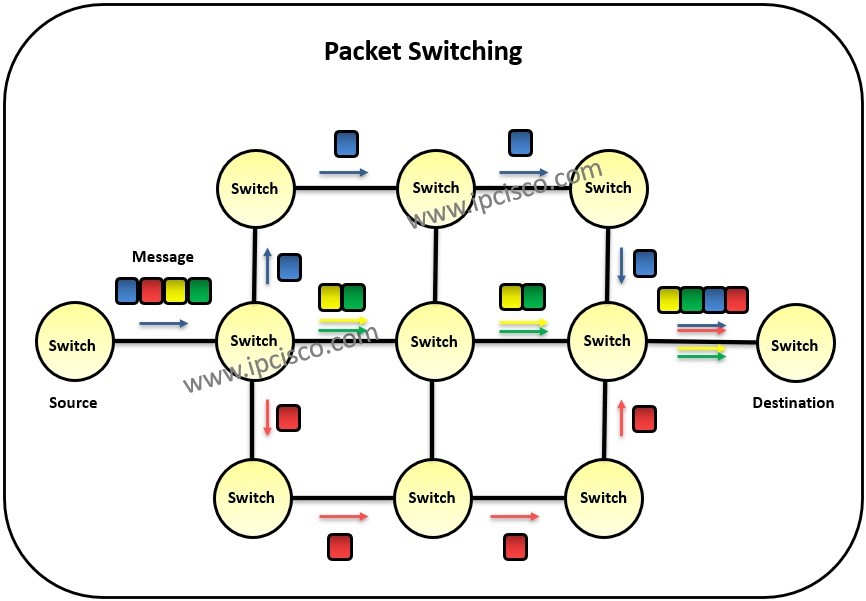
Packet Switching is another type that is done mainly dividing the message into smaller packets. By doing this, each packet become independent and with its own header, it can follow an independent path from other packets. In this type of switch ing, resource demand is less. In the header used in packet swicthing, there are different information about the packet like source ip address, destination ip addresses, sequence number etc. Here, each packet has a unique sequence number that provides identification of the packet at the destination. At the destination, the packets can be received in the correct order. After receiving the packets in the correct order, the acknowledgement is sent.
In packet switching, there are different techniques for data prioritization. Any data packet can be sent with a better priority with a better condition. Another packets can be sent over different priorities and conditions.
There are two approaches to Packet switchng. These are:
- Datagram Packet
- Virtual Circuit
What are the advantages of Packet Switching?
There are three main advantages of Packet Switch ing. These advantages are:- Cost-effective
- Reliable
- Efficient
What are the disadvantages of Packet Switching?
Beside its advantages, packet switching has also some disadvantages. So, what are the advantages of packet switching? Let’s explain these disadvantages one by one. First of all, there are different protocols and concepts used in this type of switcing. The implementation and maintenance are difficult. There are a lot of expert engineering activities. Secondly, packet swithcing cannot used for high quality and low delay required applications. And lastly, if a packet corruption occurs in packet swithcing, critical information can be lost.Message Switching
Message Switching is the technique that is similar to both circuit switch ing and packet swicthing. In other words, it is in the middle. In this type of swithcing, the entire packet is treated completely. During the data transmission, the entire message is stored in each node and when the path is available, it is sent completely. Here, there is a buffer mechanism named store and forward, so this type of switching need more resources and it is a slow. So, this type of swithcing is good for the applications that do not need fast transmission.
In Message switching, there is no to establish dedicated circuit between originator and the destination. The message includes the destination address and according to this message, dynamic routing is done between the sender and the receiver.
What are the advantages of Message Switching?
First of all, Message Switching is an efficient mechanism. Because, the data channels are shared between devices. Secondly, with Message Switching, traffic congestion is reduced. Because, there is a strore and forward mechanism. The other advantage is, there is a prioritization mechanism in packet swithcing. Lastly, the size of the message can be in different sizes in this type of switchig.What are the disadvantages of Message Switching?
The disadvantages of message switching are related to store and forward mechanism. This mechanism needs sufficient resources and it causes long delays. So, it is not suitable for the applications that need fast transmission. And this type of switcing can be a little costly because of more resource requirement.