TCPIP Model Overview
TCP IP Model is another important referance model beside OSI Model in network world.
OSI Referance Model was
Seven Layered model,
TCPIP Model is
Four Layered or
Five Layered Model. The four layer model is old one. The new one is five layered tcpip model. In common, they model the same thing. But, borders of the Layers of different models, are different.
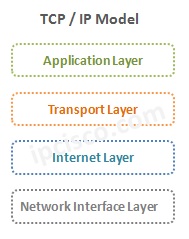
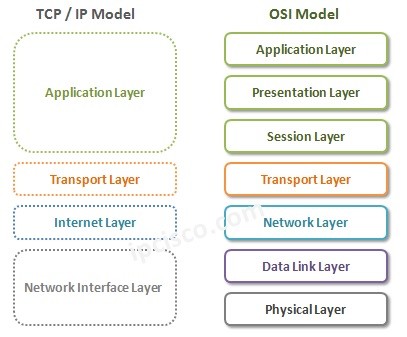
Old Four Layered Model is like below:
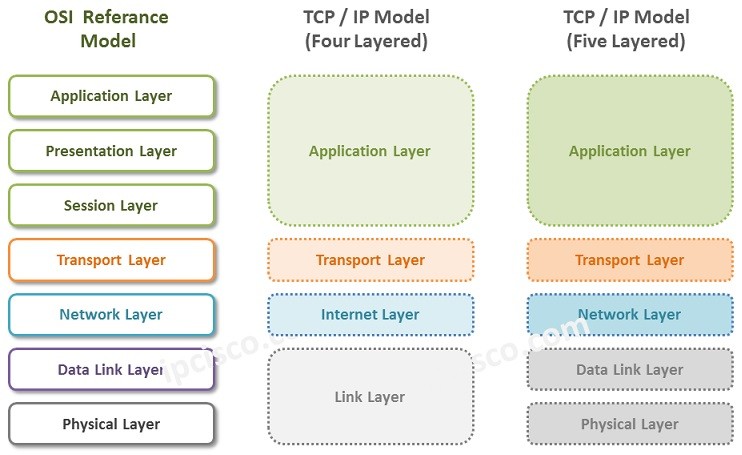
Four Layered, Five Layered TCP IP Model versus OSI Model is showed also below:
Let’s check
Five Layered TCPIP Model Layers one by one.
Physical Layer
Physical Layer is the First Layer of
TCPIP Model. The transmission of bits,
network cabling is in the responsibility of this Layer. Here, the specifications of cables an
cable connectors are very important.
Data Link Layer
The Data Link layer is responsible for creating the frames that move across the network. The packets are encapsulated by by these frames.
MAC address is used to identify the source and destination address here.
The Data Link layer protocols of TCP IP Model are
Ethernet, Token Ring, FDDI, Frame Relay, X.25, RS-232 etc. The most common protocol usedin this layer is Ethernet.
Internet Layer
The data is transmitted and routed between the source and the destination by the help of this
Internet Layer of TCP/IP Model. Internet Layer packs data into data packets known as IP Datagrams, This IP Datagrams contains Source and Destination Addresses. The main protocols used in Internet Layer are
IP (Internet Protocol),
ARP (Address Resolution Protocol),
RARP (Reverse Address Resolution Protocol),
ICMP (Internet Control Message Protocol),
IGMP (Internet Group Management Protocol) etc.
Transport Layer
Transport Layer provides the Session between end points. It manages the Sessions. Two common Transport Protocols are in this layer like OSI Transport Layer. These Trasport Layer Protocols are
TCP (Transmission Control Protocol) and
UDP (User Datagram Protocol).
Application Layer
Application Layer defines the
Application Layer Protocols and it is the Interface between the user and the Transport Layer. It summarizes the processes that make data intended for the Application. The Protocols used in this Layer are
HTTP (Hypertext Transfer Protocol),
DNS, DHCP (Dynamic Host Configuration Protocol),
FTP (File Transfer Protocol),
Telnet, TFTP (Trivial File Transfer Protocol),
SNMP (Simple Network Management Protocol),
SMTP (Simple Mail Transfer Protocol) etc.
As you see, the Protocols used in a network is the same. Only the Referance Model and its Layers are changing theorically.
TCPIP Model versus OSI Model
TCPIP Model combines some of the Layers of
OSI and behave like one Layer. Instead of OSI
Physical Layer (Layer 1) and
Data-Link Layer (Layer 2), TCP IP Model use Network Interface (Network Access) Layer. Network Layer of OSI is changed as Internet Layer in TCP/IP Model. The Transport Layer is the same as OSI Referance Model. Lastly, TCP IP Model mix the three Upper Layers of OSI Model, into one
Application Layer.
TCP IP Model Email Example
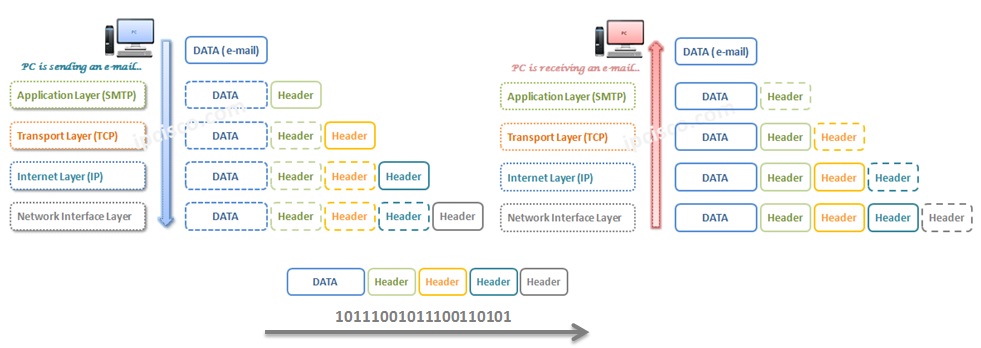
Let’s look at these picture from one end to another end. Let’s think about that, a user in a network wants to send an eMail to the other user in another network. How will the data process?
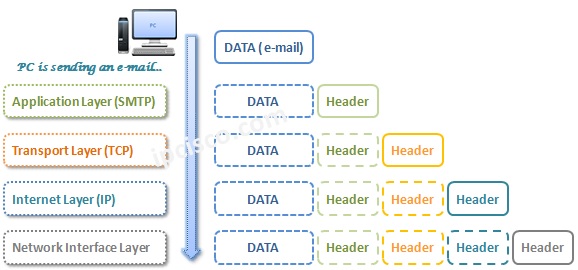
As you can see above, the data transmission starts from the PC. Beginning with the
Application Layer, in each Layer, an additional Header is added and at the media, it is sent with 1s and 0s.
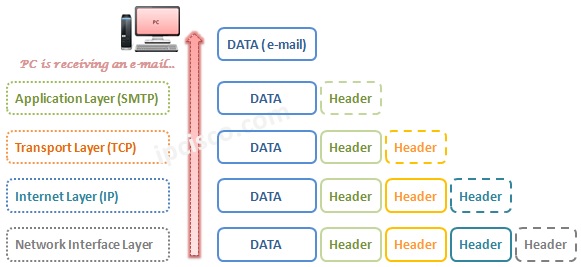
At the other end, this time the Headers are stripped in each Layer and, pure Data is transmitted to the PC.
 Network Fundamentals
 – OSI Reference Model
Network Fundamentals – TCP/IP Model
Network Fundamentals – Network Devices
Network Fundamentals – Hubs, Switches and Routers
Network Fundamentals – Network Topologies
Network Fundamentals – Network Cablings
Network Fundamentals
Network Fundamentals – OSI Reference Model
Network Fundamentals – TCP/IP Model
Network Fundamentals – Network Devices
Network Fundamentals – Hubs, Switches and Routers
Network Fundamentals – Network Topologies
Network Fundamentals – Network Cablings
[sc name=”ContentRMessage”]