
As you know, we can prioritize some of the traffic with MPLS-TE because of their nature. The high priority can be given to the voice and video traffic. Because they are fragile traffic types. During a failure normally these real time traffics send first and then the others. Like this, if a failure occurs in such a fragile traffic, this must be restored as soon as possible to provide the quality written in SLAs. This is done by MPLS Recovery.
For the ip networks, there are some Resiliency Mechanisms. We can classify these mechanisms like below:
Physical Redundancy –> redundant equipments
Protocol Layer Redundancy (IGP) –> timers, hellos, different mechanisms etc. (reactive)
Here, the IGP protocol is fast but not enough for new applications and voice. And it is a reactive solution
After all, MPLS with RSVP-TE has very fast and proactive solutions. And they provide the expected fast recovery. These solutions are Secondary Paths and MPLS FRR (Fast Reroute).
In MPLS, LDP has also a resiliency mechanism. But as you know, LSP is dependant to IGP. So this is a limit for fast recovery.
Fast recovery can be done also for SONET by “SONET APS(Automatic Protection Switching)”.
In these article series mainly we will talk about MPLS Secondary Paths and MPLS FRR(Fast Reroute).
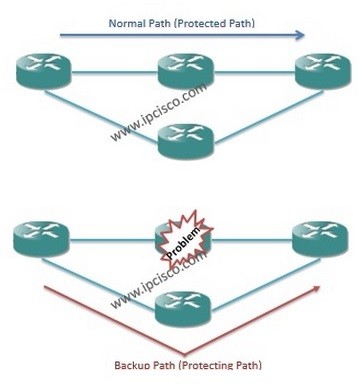
One of the choice for recovery using MPLS RSVP-TE is building a Secondary Path , that is standby. And leave this Secondary Path ready for any failure beside Primary Path. If any failure occurs on the protected path, then the standby Secondary Path take over the traffic. This is an end-to-end protection type that we will talkabout detailly in the following posts.

Normal Traffic Flow and Traffic Flow on Backup After Failure, MPLS Recovery The other recovery choise using MPLS RSVP-TE is MPLS FRR (Fast Reroute). This mechanism provide the routing of the traffic to a protection tunnel (detour or bypass), as close as the failure node. We will talk about MPLS FRR (Fast Reroute) in the following posts detailly.
You can check the other parts of these MPLS Protection and Restoration Article series below.
MPLS Protection and Restoration – Part 1
MPLS Protection and Restoration – Part 2 (End-to-End Protection, Secondary Paths)
MPLS Protection and Restoration – Part 3 (Path Diversity in Secondary Paths)
MPLS Protection and Restoration – Part 4 (Local Protection, Fast Reroute)
MPLS Protection and Restoration – Part 5 (Fast Reroute Protection Types)
MPLS Protection and Restoration – Part 6 (RSVP Objects Used for MPLS Fast Reroute)
MPLS Protection and Restoration – Part 7 (Verification Commands on Alcatel-Lucent Routers)
MPLS Protection and Restoration – Part 8 (Actions After the Failure)
MPLS Protection and Restoration – Part 9 (Convergence Factors)
MPLS Protection and Restoration – Part 10 (Juniper Configuration Samples)
MPLS Protection and Restoration – Part 11 (Juniper Configuration Samples)
MPLS Protection and Restoration – Part 12 (Juniper Configuration Samples)
MPLS Protection and Restoration – Part 13 (Juniper Configuration Samples)
…YOU CAN REACH ALL THE “MPLS” ARTICLES AND CONFIGURATIONS BELOW…
MPLS Basics
What is MPLS?
Enabling MPLS on Cisco Router
MPLS Label Distribution Protocol, LDP
MPLS Label Distribution Protocol, LDP – Part 1
MPLS Label Distribution Protocol, LDP – Part 2
MPLS Label Distribution Protocol, LDP – Part 3 (Configuration on ALU)
MPLS Label Distribution Protocol, LDP – Part 4 (ECMP)
MPLS Label Distribution Protocol, LDP – Part 5 (Export and Import Policy, Prefix Aggregation)
MPLS Label Distribution Protocol, LDP – Part 6 (T-LDP)
MPLS Label Distribution Protocol, LDP – Part 7 (CR-LDP)
MPLS, RSVP-TE
MPLS, RSVP-TE – Part 1
MPLS, RSVP-TE – Part 2(Alcatel-Lucent Configuration)
MPLS Protection And Restoration
MPLS Protection and Restoration – Part 1
MPLS Protection and Restoration – Part 2 (End-to-End Protection, Secondary Paths)
MPLS Protection and Restoration – Part 3 (Path Diversity in Secondary Paths)
MPLS Protection and Restoration – Part 4 (Local Protection, Fast Reroute)
MPLS Protection and Restoration – Part 5 (Fast Reroute Protection Types)
MPLS Protection and Restoration – Part 6 (RSVP Objects Used for MPLS Fast Reroute)
MPLS Protection and Restoration – Part 7 (Verification Commands on Alcatel-Lucent Routers)
MPLS Protection and Restoration – Part 8 (Actions After the Failure)
MPLS Protection and Restoration – Part 9 (Convergence Factors)
MPLS Protection and Restoration – Part 10 (Juniper Configuration Samples)
MPLS Protection and Restoration – Part 11 (Juniper Configuration Samples)
MPLS Protection and Restoration – Part 12 (Juniper Configuration Samples)
MPLS Protection and Restoration – Part 13 (Juniper Configuration Samples)