

OSPF Protocol can work in different network topologies. Some of these Network types are Standard and Some of them is Cisco Proprietary. Mainly,these networks types are given below:
• Broadcast Networks (Cisco Proprietary) • Nonbroadcast Multi Access(NBMA) Networks • Point-to-Point Networks (Cisco Proprietary) • Point-to-Multipoint Networks • Point-to-Multipoint Non Broadcast Networks (Cisco Proprietary) Now, let’s explain, each of these network types with entwork diagrams.
Broadcast Networks
Broadcast Networks is the mainly used OSPF topology. It uses Multicast and Broadcast to reach multi endpoints. This is a very useful network topology for an OSPF design. DR and BDR selection is done for Broadcast Networks.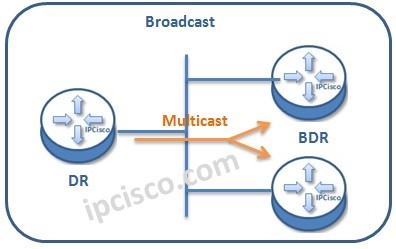
Nonbroadcast Multi Access(NBMA) Networks
Nonbroadcast Multi Access(NBMA) Networks is basically an simulation of Broadcast Networks. Each neighbour connect eachother as unicast and all OSPF packets are Unicast. OSPF DR and BDR selectio is done for Nonbroadcast Multi Access(NBMA) Networks.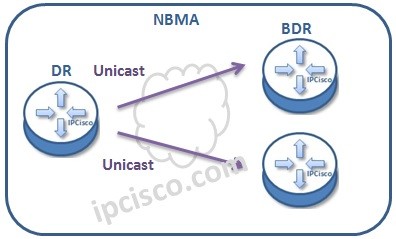
Other Main OSPF Articles…
Routing with OSPF – Part 1
Routing with OSPF – Part 2 (OSPF Adjacency)
Routing with OSPF – Part 3 (OSPF Packet Types)
Routing with OSPF – Part 4 (OSPF LSA Types)
Routing with OSPF – Part 5 (OSPF Area Types)
Routing with OSPF – Part 6 (OSPF Network Types)
Routing with OSPF – Part 7 (OSPF OSPF Router ID, Virtual Links, Authentication, Timers)
OSPF Single Area Configuration on Cisco