
IPTV Overview– Part 2

IPTV network design
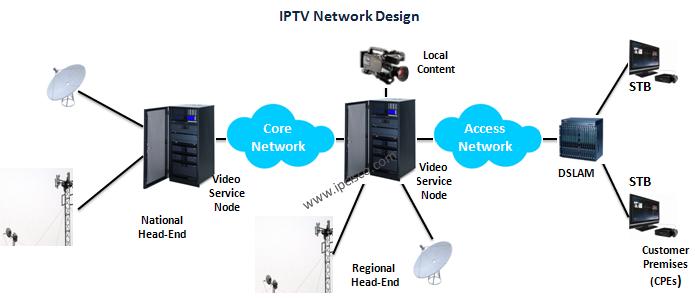
We can divide the IPTV compontents into 5 parts. These parts are defined below: National Head-End : Origination point of network broadcasts for tranmisssion over the IP network. Core Network : Generally an IP/MPLS network that transports the traffic to the access network. Access Network : Distributes the IPTV streams to the DSLAM. Regional Head-End : Origination point for local content. Customer Premises : The point that IPTV system is teminated by user Set Top Box(STB) or Computer.
Broadcast coming form the National Head-End distributes using MPEG-2 encoding to the video service nodes. Distribution over the access network is done through DSLAM (Digital Subscriber Line Access Multiplexer) and FTTH(Fiber-to-the-Home). Subscriber STB acts as the terminating interface for the network providing output to the television. For IPTV, teh channel content can be of standard or high definition. And each channel is distributed using a multicast address. [sc name=”ContentRMessage”] Other IPTV Lessons: IPTV Overview– Part 1 IPTV Overview– Part 2

Share:

Leave A Reply

Your email address will not be published. Required fields are marked *

You May Also Like

In this lesson we will give an example topology consist of Huawei switches and multicast hosts and then we will...
MLD Operations In this lesson, we will talk about the specific operations of MLD. We will see; • MLD Querier...
MLD Configuration on Cisco In this lesson we will configure Multicast Listener Discovery (MLD) on Cisco devices. Out Multicast Network...
What is MLD? Multicast Listener Discovery (MLD) is the IPv6 Multicast Group Membership Protocol. It works between the Multicast Routers...