
Beyond GPRS, EDGE(Enhanced Data rates for GSM Evolution) takes the cellular community one step closer to UMTS. It provides higher data rates than GPRS and introduces a new modulation scheme called “8-PSK”. EDGE is also being adopted by the TDMA community for their migration to UMTS.
Transition to EDGE technology is expensive, because modulation system is changing and new medias are coming. Beside these, BTSes must be upgraded and new handsets must be used.
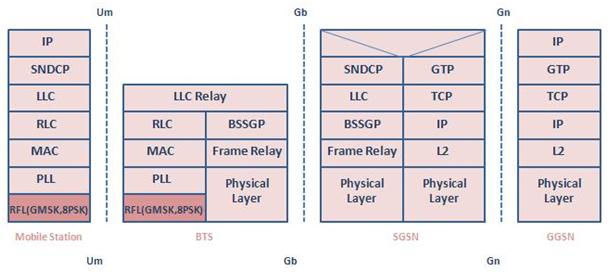
EDGE Protocol Stack

Some Important Points for EDGE
Data rates : 384 kbps and above Channel coding : Outer block coding Inner Convolutional coding Interleaving scheme for error bursts Modulation : GMSK (Gaussian Minimum Shift Keying) 8-PSK (Phase Shift Keying) Multiple Access : Combination of TDMA & FDMA Transmit Frequency bands : Mobile Station Uplink Reverse ch. 890 – 915 MHz Base Station Downlink Forward ch. 935 – 960 MHz Duplex seperation : 45 MHz RF carrier spacing : 200 kHz Number of TDMA slots on each carrier : 8 Channel allocation : 1 to 8 time slots per TDMA One time slot (Physical Chn) : 0.577 ms Frame Interval : 4.615 ms Asymmetric data traffic : Different time slots for Uplink and downlink Frequency Hopping : 217 hops/s (slow) Equalizer : 16 µs time dispersion Connectivity : Packet switched data networks such as IP and X.25 Asymmetric data traffic : different time slots for Uplink and downlink Channel coding schemes : CS-1 through CS-4, MCS1-MCS9 You can continue with the other Evolution from 2G to LTE articles… Evolution from 2G to LTE (Part 1 – GSM) Evolution from 2G to LTE (Part 2 – GPRS) Evolution from 2G to LTE (Part 3 – EDGE) Youn can join OUR Groups with the below links!!!