
In this lesson, we will focus MPLS in Networking and we will learn the answer of what is MPLS? So, What is MPLS? MPLS is a Packet-Forwarding technology which uses MPLS Labels for data forwarding decisions. It is the abbreviation of Multi Protocol Label Switching. Over time, users in networks have increased and this big traffic has brought high bandwidth and forwarding speed need. The existing routing protocols are looking to the routing table for forwarding decision on all nodes and this was overloading the routers beside causing a lot of time lose. Here Multi Protocol Label Switching brings also CEF and this bypass the slow part of this layer 3 decisions. Beside that it brings the speed of OSI layer 2 switching. In brief, MPLS Networking is combining the beneficial parts of both Layer 2 and Layer 3 of OSI reference model.
In addition to these negative facts, there were some other problems about ATM technology, while working together with Ethernet and Frame Relay. To solve all these problems IETF developed MPLS in 1997. This development could be done with existing routing protocols. But changing all the existing routing protocols was very difficult, so IETF has chosen developing a new protocol. This new protocol is using Labels for routing decisions. These labels are router specific and local significant to that router.
If you would like to learn more about MPLS, you can follow the lessons of Nokia MPLS Training.
In addition to these negative facts, there were some other problems about ATM technology, while working together with Ethernet and Frame Relay. To solve all these problems IETF developed MPLS in 1997. This development could be done with existing routing protocols. But changing all the existing routing protocols was very difficult, so IETF has chosen developing a new protocol. This new protocol is using Labels for routing decisions. These labels are router specific and local significant to that router.
MPLS Header
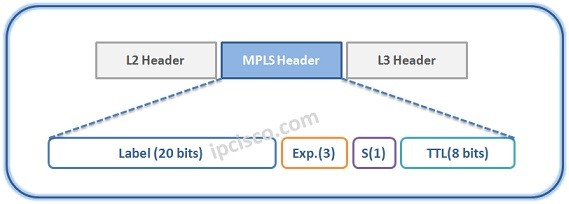
We have learned what is MPLS. Now, let’s focus MPLS Header. For MPLS Networking, a header is added between Layer 2 and Layer 3 header in packets. This MPLS Header is 32 bits long. This header consist of the below fields:- Label (20 bits),
- Experimental Bits (3 bits),
- Bottom of Stack (1bit),
- Time to Live (8 bits)
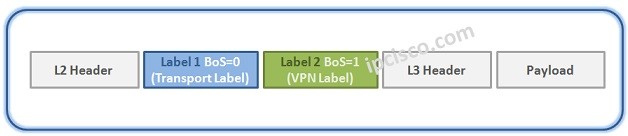 As an example, you can check the below packet capture that includes also an MPLS Header. Here, MPLS Header is shown with blue rectangle. As you can see Multi Protocol Label Switching header is between the Layer 2 header (ethernet II header) and Layer 3 header.

You can test your knowledge with MPLS Questions
MPLS Router Types
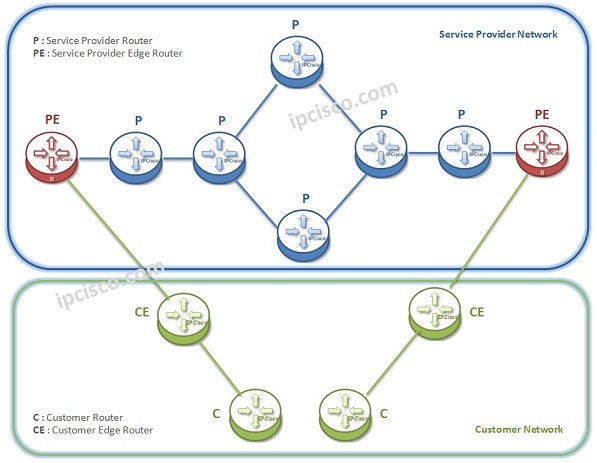
Firstly, I want to talk about Router terms used in this technology. There are different routers used in MPLS Technology. These routers are given below:
 Instead of Provider Router or Provider Edge Router, we can also use LSR (Label Switching Router) and Edge LSR (Edge Label Switching Router) terms for the routers capable of label switching. Specifically, Edge LSRs can be divided into two as Ingress Edge LSR and Egress Edge LSR. The below shape shows this clearly:
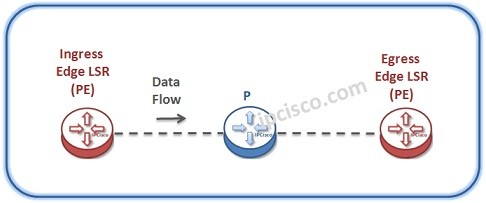
The packet comes to Ingress Edge LSR firstly from the customer. Then it travels in the Service Provider network through various LSRs (Provider Routers). Lastly, it exists from the Service Provider network with Egress Edge LSR.
- Customer Router (C)
- Customer Edge Router (CE)
- Provider Router (P)
- Provider Edge Router (PE)
Instead of Provider Router or Provider Edge Router, we can also use LSR (Label Switching Router) and Edge LSR (Edge Label Switching Router) terms for the routers capable of label switching. Specifically, Edge LSRs can be divided into two as Ingress Edge LSR and Egress Edge LSR. The below shape shows this clearly:
Label Distribution Protocols
The labels that will be used in MPLS network are distributed with some Label Distribution Protocols. And with these labels forwarding decision is done. As you remember from ip routing, this decision is done through IP addresses in normal routing. MPLS technology is basically a concept that changes a layer 3 routed network to a switched network.
There are four main protocols for Label Distribution. In other words, there are four Label Distribution Protocols. The widely used standard one is LDP (Label Distribution Protocol). You can find all Label Distribution Protocols below:
- LDP (Label Distribution Protocol)
- RSVP-TE (Resource Reservation Protocol-Traffic Engineering)
- CR-LDP (Constraint-Based Routed LDP)
- MP-BGP (Multi Protocol BGP)
MPLS Tables
There are four type table that is related to Multi Protocol Label Switching. This tables are formed with CEF (Cisco Express Forwarding) mechanism and the Label Distribution Protocols. So what are the tables used in MPLS? You can find Multi Protocol Label Switching tables below:
- RIB (Routing Information Base): It is the classical routing table of the router. This table contains the classic routing information about the destination network.
- FIB (Forwarding Information Base): It is formed from RIB by CEF to accelerate route forwarding process.
- LIB (Label Information Base): It is the table that is formed by the label distribution protocol and it contains all the labels known by an LSR. It contains the label, LSR and network information.
- LFIB (Label Forwarding Information Base): It is the routing database for labeled packets. It determines how the incoming label will be forwarded to the next-hop.
Control Plane ve Data Plane
MPLS works in two different systems in Routers. These systems are Control Plane and Data Plane. So, what is MPLS Control Plane? What is MPLS Data Plane?- Control Plane: Control plane is the system in which the Layer 3 Routing Protocols are work and the routing information is store. Beside protocols like RSVP and LDP works here.
- Data Plane: Data planeis the system that forwards the Label Based data. Data plane does this with the table (LIB) stored in control plane.

MPLS Benefits
So, what are the benefits of this new concept, what is the benefits of MPLS? Multi Protocol Label Switching Technology has many benefits to the networks. Some of these MPLS benefits are given below:- It combines the beneficial parts of Layer 2 and Layer 3 of OSI model,
- It decreases the router load, provide speed and performance increment,
- It provides easy managable VPN definitions between edge devices,
- With traffic engineering, it provides management of the traffic,
- It simplifies the IP forwarding over ATM devices,
- And more…
MPLS Interview Questions
Question 1: What is MPLS?
a) An encryption technology which uses hashes for secure transfer. b) An organisation for international data forwarding. c) A packet-forwarding technology which uses labels for data forwarding .Question 2: How many bits are there in an MPLS Header?
a) 20 b) 24 c) 32 d) 64 e) 128Question 3: How many bits of MPLS Header is used for Label?
a) 1 b) 3 c) 8 d) 20 e) 32Question 4: Which MPLS Header Part is also used for Quality of Service?
a) Label b) Experimental Bits c) Bottom of Stack d) Time to LeaveQuestion 5: Whick routers reside in MPLS networks? (Select two)
a) Customer Router (C) b) Customer Edge Router (CE) c) Provider Router (P) d) Provider Edge Router (PE)Question 6: …. is an MPLS Router that is located at the edges of the Service Provider Networks.
a) Customer Router (C) b) Customer Edge Router (CE) c) Provider Router (P) d) Provider Edge Router (PE)Question 7: Which one is formed by the label distribution protocol and contains all the labels?
a) RIB b) FIB c) LIB d) LFIBQuestion 8: Which one is the simplest way for MPLS Label Distribution?
a) LDP b) RSVP-TEQuestion 9: RSVP and LDP works in …. in an MPLS Network.
a) Data Plane b) Control PlaneQuestion 10: Which ones are benefits of MPLS?
a) Combines the beneficial parts of L2 and L3 b) Provides easy managable VPN solutions c) Provides Traffic Engineering d) Provides speed and performanec increment e) All of themAnswers: 1)c 2)c 3)d 4)b 5)c,d 6)d 7)c 8)a 9)b 10)e
[sc name=”ContentRMessage”]